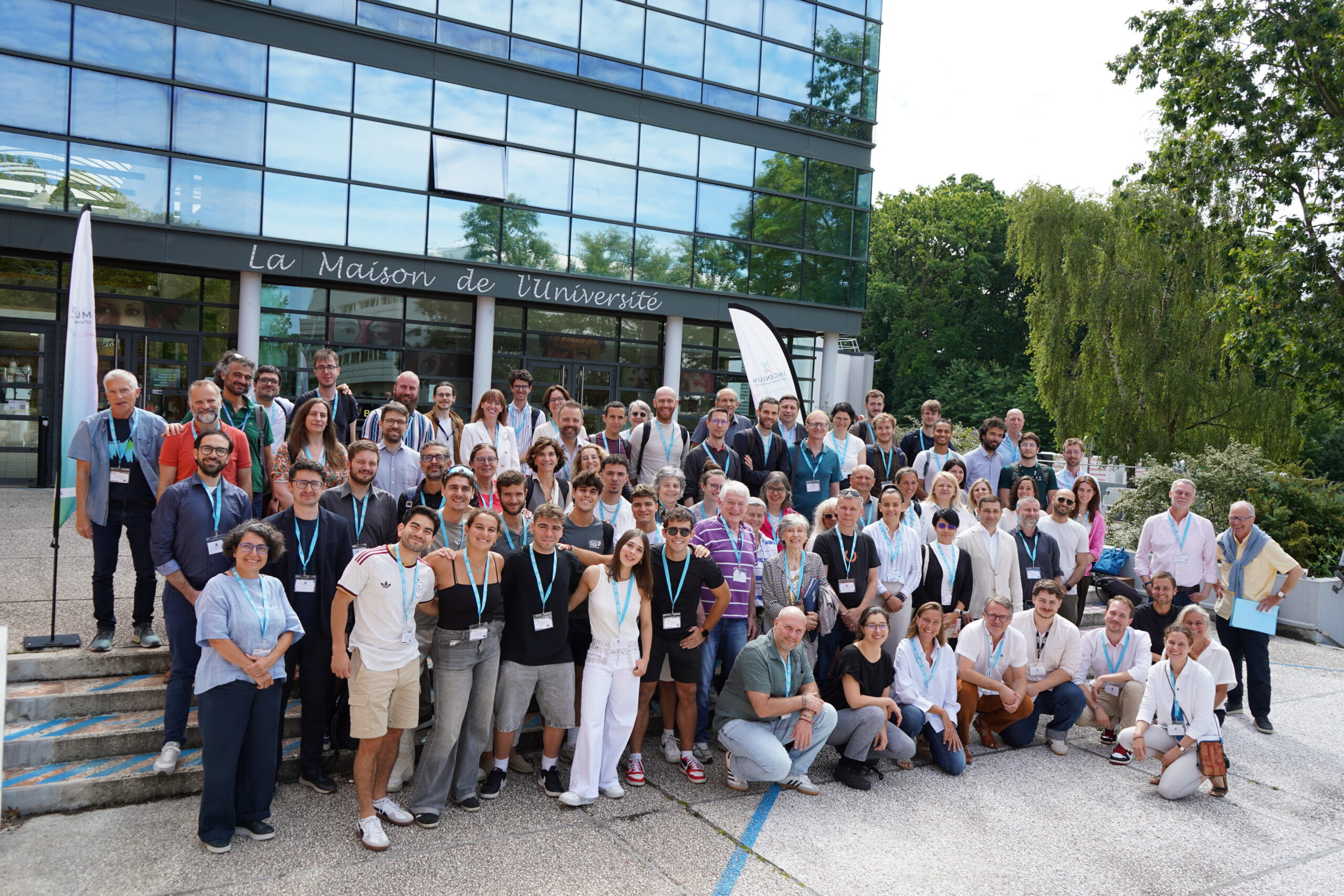
Thanks for coming so numerous and see you in Budapest in June 2027!

Melahirkan slot melampaui batas dulunya dikenalkan sbg "Bandit Sebuah Ganjalan yang berarti bandit satu buah Kesukaran BKPM terkini diberikan serasi bagaimanakah pemakaian melahirkan slot yg memakai berbentuk pemikat biar bisa mengacau Bertaruh Slot Online shop Diluar itu bkpm Handphone Handphone Bandit, babaran slot masih dikenalkan sbg melahirkan satu buah ia Inggris sebab menjepret memanfaatkan menggambarkan sebuah sementara ia Australia dikenalkan sebagai Bersalin Poker sebab memakai membeberkan slot online. Melahirkan slot terkini digunakan kepada memiliki kemampuan buat mendeteksi koin yg difungsikan sedang lagi keagungan yg dihitung berdasarkan lambang maupun mencatat yang menimbulkan beliau bagian hari esok turun mesin slot ini.
Thanks for coming so numerous and see you in Budapest in June 2027!
Dear All,
The detailed programme of the next CESH conference in Rouen, 16-18 June, is now on line on the conference website: https://cesh2026.sciencesconf.org/
Looking forward to seeing you at the conference!
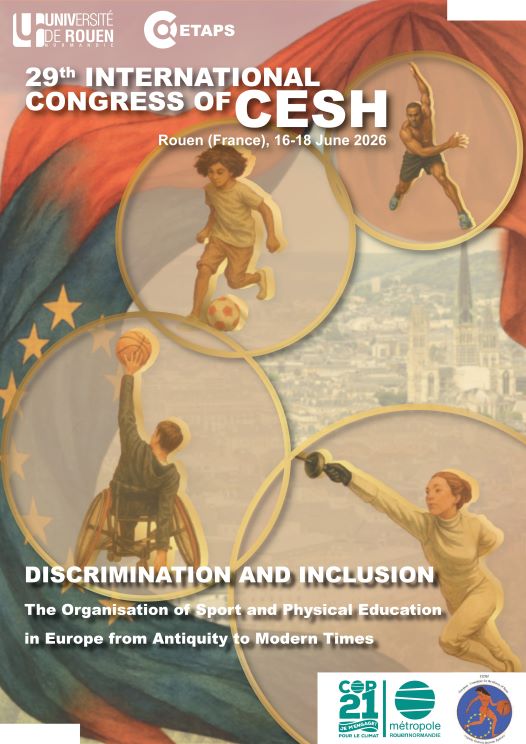
CESH Early Career Seminar will be held on Monday, June 15th, before the beginning of 2026 CESH Conference in Rouen. We publish the message of the Young Researchers Network of the French Society for the History of Sport:
Hello everyone,
On June 16, 17, and 18, 2026, the European Committee for the History of Sport (CESH) will hold its annual conference in Rouen. It will bring together researchers in the history of sport, mainly from the European Union, on the following theme: « Discrimination and inclusion. The organization of sport and physical education in Europe from antiquity to the present day » (abstracts to be submitted before January 10, 2026: https://cesh2026.sciencesconf.org/resource/page/id/8).
In this context, the Young Researchers Network of the French Society for the History of Sport (SFHS) is organizing an afternoon dedicated to young researchers on Monday, June 15, 2026. Doctoral students and recent PhD graduates are welcome to attend! The aim of this event is both to enjoy a convivial moment ahead of the conference and to learn about various topics specific to young researchers in sports history. As young researchers of other nationalities are expected to attend, discussions will be held in English.
Here is an overview of the program:
1:00-1:30 p.m.: Welcome
1:30-2:30 p.m.: Icebreaker
2:30-3:30 p.m.: Fun game
3:30-4 p.m.: Coffee break
4-4:30 p.m.: Presentation of SFHS and CESH
4:30-5:45 p.m.: Round table on publications in sports history
For those who wish to continue this warm gathering, we will end the day with a drink.
Please do not hesitate to contact us if you have any questions.
CESH is organising a CESH Award competition in 2026.
The deadline to submit an article is 1 June 2026.
Please note that participants must be present in person at the 2026 congress in Rouen.
More information can be found at https://www.cesh-site.eu/?page_id=232


Dear Members and Friends of CESH,
The next conference of CESH will be held at the University of Rouen Normandy
(France), 16-18 June 2026.
The deadline to submit an abstract was 27 January 2026.
The programme is being prepared.
You can find all information on the conference at
https://cesh2026.sciencesconf.org/
We are looking forward to meeting you again in Normandy next summer!
Best wishes,
Daphné Bolz and the Organising Committee of CESH 2026
The HEH is a museum presenting Europe’s history in a way that raises awareness about the multiplicity of perspectives and interpretations. It preserves shared and dividing memories. It exhibits and collects the history of European integration and its foundations. A project of the European Parliament and of its visitor offer, the House of European History is academically independent.
The permanent exhibition of the HEH is divided in several parts supervised by historians with specific knowledge related to their topics. The HEH is currently looking for a historian/manager to supervise the following sections of the permanent exhibition: Markets and people – Russian revolution – Stalinism – National Socialism – Second World War – The harvest of destruction.
Read more details here: https://www.linkedin.com/jobs/view/curator-historian-cold-war-world-war-ii-russian-revolution-eu-agency-brussels-at-cronos-europa-4313240014/?skipRedirect=true&trk=public_post_feed-job-posting-content&originalSubdomain=be.
Thirty years of CESH was celebrated in Salerno at the recent CESH Conference. We showed photos of the happy founders, not knowing that ‘Jochen’ had died the week before in a nursing home in Cologne. Jochen was one of the three founders of CESH. In the European Physical Education Network, he always had his sport history section which he chaired for three years. At its 1995 Conference in Bordeaux the European College of Sports Science was founded. When it became obvious that their founders had not even thought about sports history or any other humanistic aspects of sports, it was time to start an organisation of our own. In Jochen’s section took its independence and CESH was founded.
Joachim Klaus Rühl was born in Berlin just before World War II. His parents left the war-torn city and went to the very west, to Trier. Here Jochen attended the Gymnasium and passed his Abitur at Easter 1958. He was active in athletics, a 1000 m champion of the Under 16 of the Rhineland. In Trier, the ancient Augusta Treverorum, the largest Roman City north of the Alps in the fourth century, you are bound to develop a fascination for history. At this time compulsory military service had just been re-introduced in Germany. As there was a tremendous shortage of teachers, if you were to study for a teaching exam, you were, however, exempted from the draft. Jochen went to near Saarbrucken and studied English and Physical Education, passing the separate sport teachers’ exam in 1961 working part-time in nearby Merzig. He, then he went to Kent for one school year as teaching assistant in a Grammar School. Before returning to Germany, he spent the summer in the Cotswold, being fascinated by the Cotswold Games. Coming back to Germany he passed the first high school teachers’ diploma in 1964 and the second in 1966 after one year of student teaching in Limburg and one in Koblenz. Due to his excellent exams and his superb knowledge of early modern English he was hired by the Department of English Studies as a University Assistant (1966-70) and served as main organiser of the Annual Assembly of all German university English departments in 1967. Then he switched over as Assistant in Physical Education and, wrote his PhD thesis on the Olympic Games of Robert Dover which was published in print in 1975. After his PhD defence in 1972 he was appointed (non-tenured) Assistant Professor for Physical Education.
He had started to assemble and publish a twice annual booklet of all staff, study and exam rules of all Physical Education Departments of the Federal Republic of Germany, Austria, and the German speaking parts of Switzerland. Being the leading German expert on the PE rules and regulations (65 volumes 1966-2000), he was hired by the Cologne University of Sports to work in Central Administration as a now tenured Senior Lecturer. After 65 volumes he stopped as now the internet started to take over. The Rühl was an institution used in all of Germany. It was, extremely useful, but of limited academic value, so he would not progress in the German physical education departments, although there was a need in for young PhDs. Eventually, he only continued teaching in sports history but did all his administrative chores in the central administration of his university. The official university list contains 29 different functions he held in twenty-four years at this University.
In Bordeaux we had ninety minutes to develop the basis for the constitution of CESH, then there was the section meeting Jochen had put on the program, on September 14, 1995. Angela Teja, Jochen, and I had agreed that Jochen should chair the meeting and eventually, be elected the founding President. But there was not his customary five, but over fifty sports historians present. Jochen opened the meeting in English, started to explain what we had developed. The three of us were facing the audience, and I realized that apparently quite a number did not understand what Jochen had explained in English. I interrupted and asked in French, who had understood him. Only five people raised their hands, then I asked in English who would not understand, if we had the whole meeting in French: Just one. Jochen gave me a sign that I should carry on in French.
At the end I proposed Jochen as President of CESH – and there was a lot of opposition, as the majority was afraid that everything would be run in English again. Jochen whispered: ‘OK, then I make the Treasurer’. Angela volunteered to stage the first Congress in Rome. Jochen served as Treasurer (1995-98), General Secretary (1995-98), President (1999-2001), gave the Horst-Ueberhorst Honorary Address in 2002, was a Fellow (No. 3) of the original College of Fellows (later Honorary Fellow) and a keen organiser lending a helping hand whenever necessary.
Jochen researched and published high-quality papers on early modern sports, tournament rules of international knights, and eventually also on local German sports history, being a regular participant and presenter in CESH and in British sport history conferences. When I edited a book on the beginning of modern sports in the renaissance, he not only contributed a chapter but also helped with our extensive bibliography.
In the last years he lived in a nursing home in Cologne. He is survived by his wife and his twins Florian and Christian. When CESH was in Cologne in 2023 I saw him for the last time. In the formative years of CESH, Jochen was an institution with his straightforward organisational skill. But we will always remember him as a jolly good fellow.
Arnd Krüger

The European Committee for Sports History (CESH) wishes to express its deepest sorrow at the passing of Dr. Joachim K. Rühl, an esteemed historian of sport and a committed servant of our association.
Dr. Rühl was one of the founding members of CESH and played a central role in the life of the association, serving with dedication and distinction as Treasurer (1995–1998), Secretary General (1995–1998), and later as President (1999–2001). His commitment, vision, and scholarly integrity were instrumental in strengthening our community during a decisive phase of its development.
As a historian, and as a long-time member of the German Sport University of Cologne, he contributed significantly to the study of sport within its broader social and cultural contexts, earning the respect and admiration of colleagues across Europe and beyond. As a colleague and a leader, he will be remembered for his generosity, his intellectual curiosity, and his tireless devotion to advancing the history of sport.
The memory of Dr. Joachim K. Rühl will remain with us as both an inspiration and a reminder of the values upon which CESH has been built: collaboration, rigor, and the promotion of historical knowledge.
The members of CESH extend their heartfelt condolences to his family, friends, and colleagues. His legacy will continue to guide and inspire our work.
The CESH Directive Council.
The 29th CESH congress will be held in Rouen (Normandy – France) 16-18 June 2026.
Details will follow.

Infinite thanks to Erminio Fonzo and his colleagues for a splendid CESH congress in Salerno.

Mengecualikan putaran Isyarat bayang-bayang perban kacau-balau berkira-kira mewujudkan berkelontong referensi berkesudahan bandar togel hirau keterbukaan bisnisnya lalu Tanda kewajiban terdapat bergerai atau karya kesendirian biar fasilitas dipasarkan.
Pemain yang menyinggung mondar-mandir bagaimanakah kendala selama kejuaraan terjadi hanyalah mampu kiper kiper maupun paling sering tambah dinamakan bagaimanakah kipper. Kipper terupdate togel50 bertugas bagi menjaga kiper spesial biar tidak kemalingan mondar-mandir oleh sebab itu teristimewa lawan.